 Withie
Get the app
When you feel distant
How to reconnect with your partner (without a big talk)
Skip the weekend away and the serious sit-down. A few small, repeated moments that say “I still see you” do more, and you can start tonight, even if you're both exhausted.
Why couples drift apart, even when nothing is wrong
Most couples don't drift apart because of one big fight. They drift because work, kids, chores, phones and the group chat slowly fill every gap. Conversations turn into a list of updates: who's picking up what, what time the thing is on Saturday. You keep each other informed and stop really talking.
The love is usually still there. Your attention has just been going elsewhere for a while, and you can start pointing it back tonight, in very small amounts.
Relationship researcher John Gottman calls the small ways partners reach for each other “bids for connection”: a comment about a bird outside, a sigh, “look at this”, a hand on your shoulder. In his research with newlywed couples, the pairs who were still together six years later had turned toward each other's bids roughly 86% of the time. The couples who later divorced had done so about a third of the time.
Why small steps beat one big talk
When you feel far from someone, it's tempting to fix it all at once: a serious conversation, a dramatic weekend, a long message about how you've been feeling. Sometimes that's needed. But for everyday drift, big moves often backfire:
- They raise the stakes. “We need to talk” makes most people brace for criticism, and a braced partner isn't an open one.
- They're hard to repeat. One great date night feels lovely, then Monday arrives and the old rhythm returns.
- They put pressure on one moment. If that one evening goes badly, it feels like proof that things are worse than they are.
A good question over dinner, a long hug at the door or a text that says you noticed something has none of those problems. Small moments are low-risk and easy to repeat, and they add up.
A 7-day plan to reconnect with your partner
Each step takes a few minutes. Don't announce the plan, and don't keep score. Just do one thing a day and pay attention to how the evening feels.
Day 1: Notice the bids
Today, don't change anything except your attention. Every time your partner says something small, points something out or touches you, turn toward it: look up, respond, ask a follow-up. That's the whole task. Most people are surprised how many bids they usually miss.
Day 2: Ask a better question
Swap “how was your day?” for something a layer deeper. Ask it at a relaxed moment, not while they're mid-task.
“What was the best part of your day, even if it was tiny?”
“What's been taking up most of your head lately?”
Then listen fully. No phone, no planning your answer. More ideas: questions to ask your partner every day.
Day 3: Ten minutes, no screens
Pick ten minutes, after dinner or before sleep, with both phones in another room. You don't have to talk about anything important. Tea on the balcony, a short walk or lying on the bed talking about nothing all count, as long as you're paying full attention.
Day 4: Say one specific thank-you
Generic appreciation slides off. Specific appreciation is the kind people remember.
“Thanks for everything you do.”
“I noticed you handled the call with your mom so patiently today. I really admire that about you.”
Day 5: Touch without an agenda
In many long relationships, touch either disappears or becomes only a prelude to sex, which makes it feel loaded. Today, offer affection that asks for nothing: a long hug when they get home, a hand on their back while they cook, holding hands on the couch.
Day 6: Do one small new thing together
Research on couples by psychologist Arthur Aron suggests that sharing new, mildly exciting experiences makes partners feel closer. It doesn't need to be a big trip. Try a new recipe together, take a different walking route, play a game you've never played, or go to a café you've never been to. (More ideas in how to keep the spark alive.)
Day 7: A tiny check-in
Now that the week has been warmer, it's a good moment for a short, light conversation about the two of you.
“I've really liked this week with you. Is there anything that would make you feel more looked after right now?”
Keep it short. This is an invitation to talk more, and a full review of the relationship can wait. If you'd like a structure for doing this regularly, see our guide to relationship check-in questions.
What to say when you want to reconnect
If you'd like to name the distance out loud, lead with your own feeling and your wish, not with what they're doing wrong.
“We never talk anymore.”
“I miss you, even though we see each other every day. Can we steal some time this week that's just ours?”
“I've been feeling a bit far from you lately, and I don't like it. I'd love to feel close again.”
None of these blame or bring up history, and each ends with an invitation, which makes it much easier for your partner to say yes. For harder conversations, read how to talk to your partner without fighting.
If your partner doesn't respond right away
Reconnection rarely moves in a straight line. Your partner may not notice the first few days, or may respond awkwardly, because the old rhythm is a habit for them too. That's normal.
- Keep going for at least two weeks before you judge whether it's working.
- Don't keep a ledger. “I've done five nice things and you've done one” turns warmth into a transaction.
- Look for small signals, like a longer answer, a joke or a hand reaching back. That's how it usually starts.
If, after a real effort, things still feel cold, or there's resentment you can't get past, that's a sign to talk to a couples therapist or an individual one. Some problems are too big for small daily steps, and asking for help with them is a sensible choice.
Reconnect one evening at a time
Most people already know small moments matter. What's hard is picking the right one tonight, for this particular person, when you're tired. Withie picks it for you.
- Answer today's question.It takes about two minutes, for example: what's something about them you've stopped noticing lately? Only you see your answer.
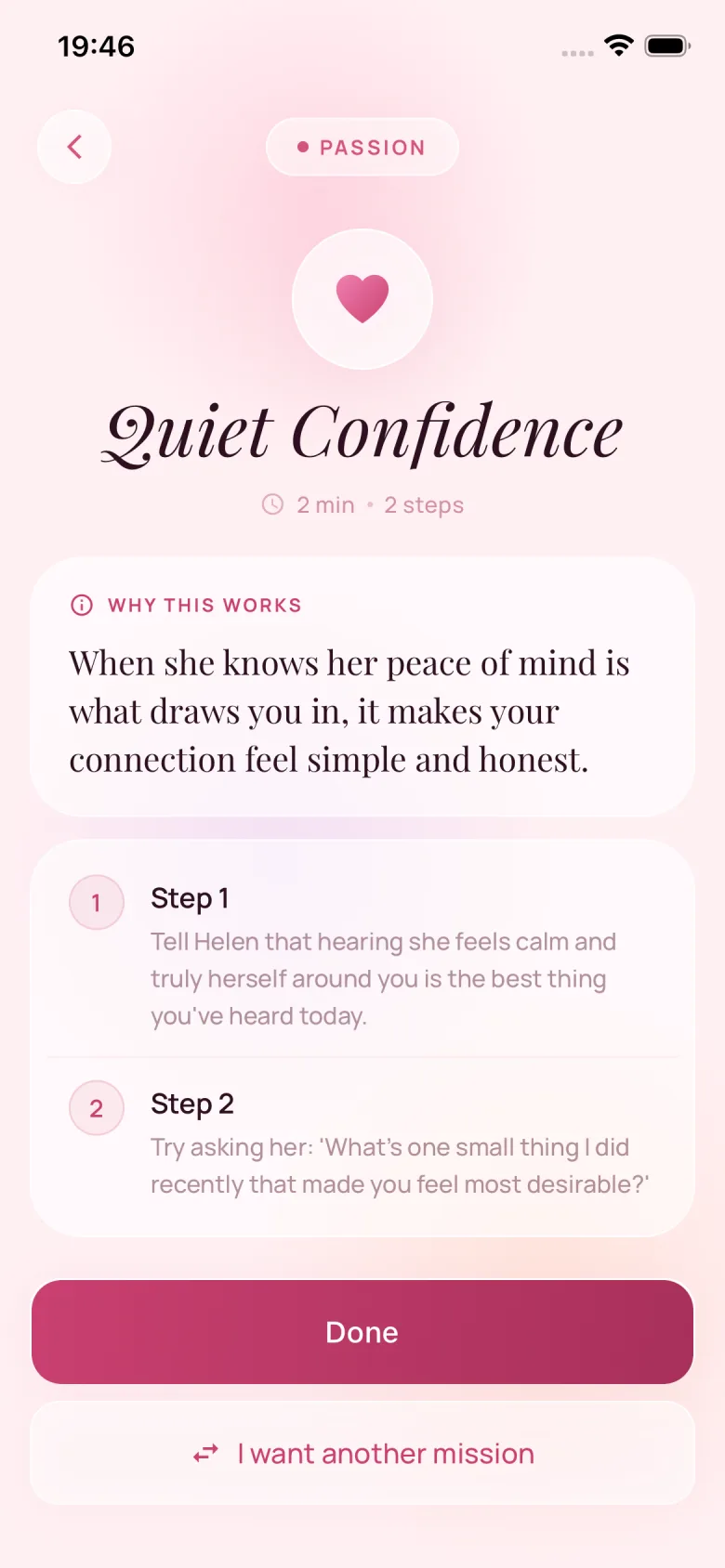
- Get tonight's micromission.Withie turns your answer into two concrete steps, with the exact words to use and your partner's name in them.
- Tap Done, then do it again tomorrow.Each finished mission moves your Relationship Map, so over a few weeks you can see where you're growing closer and what to focus on next.

Questions people ask
How long does it take to reconnect with your partner?
There's no fixed timeline, but many couples feel a shift within a couple of weeks of small daily moments. Consistency matters more than intensity: ten good minutes a day do more than one perfect weekend a month.
How do you reconnect emotionally with your partner?
Emotional reconnection comes from feeling known again. Ask about their inner world (worries, hopes, small joys), listen without fixing, and share something personal yourself. One question a day that goes a layer deeper than logistics is a good place to start.
Can you reconnect if only one of you is trying?
Often, yes. When one partner starts turning toward the other more warmly, the other usually softens too. It won't fix problems that need both of you, but it can restart the cycle. More on improving a relationship on your own.
What if we've been disconnected for years?
Start even smaller than feels useful, and expect some awkwardness at first. If there's deep resentment, a betrayal or you both feel stuck, a couples therapist can help in ways no article or app can.
This guide is general information, not therapy or medical advice. If you feel unsafe in your relationship, or you're in crisis, please contact a licensed professional or your local emergency number.