 Withie
Get the app
When you feel distant
How to improve your relationship on your own
Maybe your partner won't do couples therapy or would roll their eyes at a relationship app, or you're simply the one who thinks about this stuff. One person can still change much more than they expect.
Can one person really change a relationship?
Think of your relationship as a dance. Each of you has steps you tend to repeat: one pursues, one withdraws; one criticizes, one defends; one goes quiet, one gets louder. Each of you is half of that dance.
When one partner reliably changes their steps (responds with curiosity instead of defensiveness, reaches out instead of waiting, says the warm thing instead of the sharp one), the dance can't stay exactly the same. Your partner may not change overnight, but over weeks they usually start responding to the new steps.
That's why so much good relationship advice is about your own side, the only side you can actually move.
What you can change on your own
- Your attention. How often you notice and respond to your partner's small attempts to connect.
- How you start conversations. Soft, specific openings instead of criticism.
- Your appreciation. How often your partner hears something specific and kind from you.
- Your reactions. Taking a breath, pausing a heated talk, choosing not to escalate.
- Your own wellbeing. Sleep, stress and friendships all affect how you show up at home.
- The small rituals. A morning coffee together, a walk, a proper goodnight. You can start these without a vote.
- Your curiosity. Asking questions about who your partner is now, which may differ from who they were five years ago.
What you can't do alone
Be honest about the limits too, so you don't end up blaming yourself for things outside your control.
- You can't make your partner change. You can invite and influence them and set an example, but the decision is theirs.
- You can't repair a betrayal by yourself. Infidelity, serious lies and broken trust need the other person's honesty and effort.
- You can't fix addiction, abuse or control. If you feel afraid, controlled or belittled, please reach out to a professional or a support line instead of trying to work around it.
- You can't carry it forever. If you're the only one investing for a long time, resentment builds. Trying alone works as a start, but it can't be the permanent arrangement.
7 small daily steps that shift the dynamic
1. Turn toward one more bid a day
When your partner shares a thought, a sigh or a meme, respond with interest. It's a tiny habit with a big effect on a relationship.
2. Replace one criticism with a request
“You never put your stuff away.”
“Could you clear the table tonight? I'm wiped.”
3. Say one specific thank-you
Skip “thanks for everything” and try “thanks for dealing with the landlord, I know you hate those calls.”
4. Ask a better question
One layer deeper than logistics. See our list of questions to ask your partner every day.
5. Do one small act of care
Tea made the way they like it, a task they dread, a long hug. Plenty of ideas in 40 small things to do for your partner.
6. Pause before you react
When you feel a sharp reply coming, take one breath. Ask a question instead: “What did you mean by that?”
7. Repair quickly
When something goes wrong, be the first to soften: “That came out wrong, can I try again?” Here's more on what to say after a fight.
Without turning it into a project
A common trap is announcing it: “I'm working on our relationship, and I need you to work on it too.” To many partners that sounds like criticism, or like homework, and you don't need to frame it at all.
Start being a bit warmer and more attentive, one small thing a day, without keeping score of who's doing more, and notice what changes. If you'd like to talk about it eventually, talk about how much you've enjoyed the last few weeks and leave the plan out of it.
If your partner won't go to couples therapy
Many people start here: they suggested couples counseling and got a firm no. That's frustrating, and you still have options.
- Individual therapy is a real option. A good therapist can help you understand your part of the pattern, cope with the stress and get clear about what you need.
- Change the ask. “Therapy” can sound like an accusation. “Would you read this short thing with me?” or “Can we try a weekly check-in?” is a much smaller step. (Here's how to do one.)
- Keep doing your part. Partners sometimes become curious about therapy after seeing that things can improve.
Built for the one who goes first
In most couples, one person thinks about the relationship more and is ready to start. Withie was designed for that person: a two-minute daily practice that needs nothing from their partner, not even an account or an announcement.
- Reflect on your side.One private question a day helps you notice what you're bringing to the relationship and what you're missing.
- Do your part tonight.A 2-minute micromission for your partner by name: a softer opener, a specific thank-you, a moment of attention.
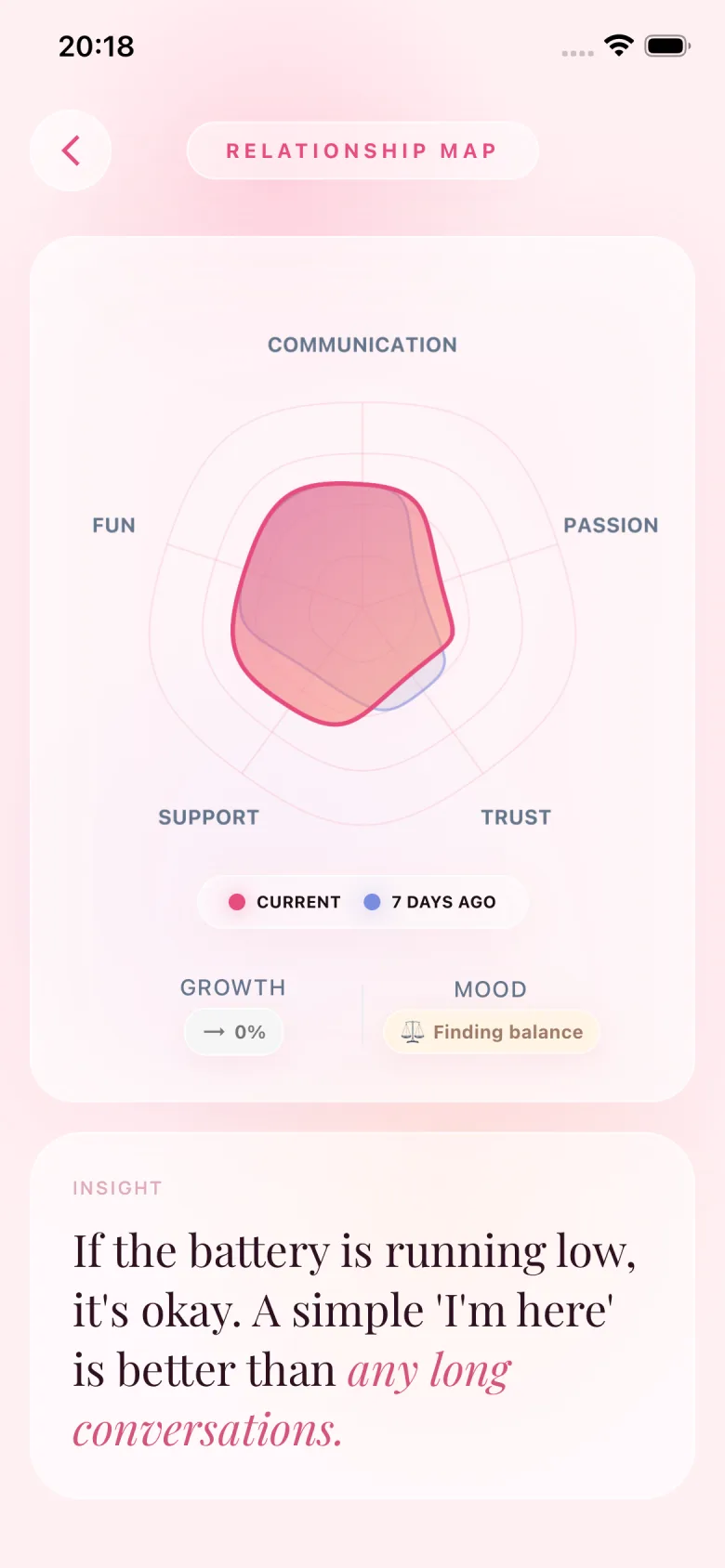
- Watch the pattern shift.Your Relationship Map compares this week with last week across communication, passion, trust, support and fun.

Questions people ask
Can one person fix a relationship?
One person can't fix everything, but one person can change the pattern. When you respond differently (warmer, calmer, more curious), your partner's responses often change too. What one person can't fix alone: problems that require your partner's honesty or effort, such as infidelity, addiction or abuse.
What do I do if my partner won't work on our relationship?
Start with what you can do without their buy-in: small daily acts of attention, softer conversations, specific appreciation. Avoid ultimatums and announcing your plan. If nothing changes after months of real effort, consider individual therapy to get clear on your own needs and options.
Is it manipulative to work on the relationship without telling my partner?
No. Manipulation means using tactics to get something out of someone. Being kinder, more attentive and more curious is how good relationships are made, and honest warmth and kind words have nothing hidden in them.
When should I stop trying alone?
When you've been the only one investing for a long time and nothing changes, when you feel consistently unseen or disrespected, or when there's any control, threat or abuse. At that point, talk to a therapist rather than trying harder on your own.
This guide is general information, not therapy or medical advice. If you feel unsafe in your relationship, or you're in crisis, please contact a licensed professional or your local emergency number.