 Withie
Get the app
When you feel distant
The roommate phase: what it is and how to get out of it
Shared calendars, split chores, goodnight from opposite sides of two glowing phones. If your relationship has started to feel like a well-run flat share, you're in the roommate phase, and couples do find their way back.
What is the roommate phase?
The roommate phase (sometimes called “roommate syndrome”) is a stage in a long-term relationship where you and your partner function well as co-managers of a life but rarely connect as a couple. You split the chores, coordinate the calendar and might even be very kind to each other, but the romance, curiosity and physical affection have faded into the background.
It's extremely common, especially after moving in together, having a baby, starting demanding jobs or just being together for a long time. It rarely starts with anything dramatic. Usually efficiency has won every small decision for a few months in a row.
Signs you're in the roommate phase
- Most of your conversations are about logistics: who's doing what, when, and what you're out of.
- Evenings mean side by side on the couch, each on your own screen.
- Physical affection is rare, or happens only on a schedule.
- You don't really flirt anymore, in person or by text.
- You know their calendar better than you know what's on their mind.
- Date nights have quietly disappeared, or turned into errands together.
- You feel more like teammates than lovers, even if you're good teammates.
Why couples end up as roommates
Efficiency. Running a household is a lot of work, and dividing it up is the sensible, fast way to do it. It also leaves fewer moments of doing things together just for the sake of it.
Kids and life transitions. After a baby especially, energy, sleep and time all go to survival. Many parents describe feeling like co-workers on a very demanding shift.
Avoiding friction. When conversations about the relationship have gone badly before, it can feel safer to keep things practical, and over time practical turns into distant.
No more novelty. Desire and fascination feed on newness and seeing your partner as a separate, interesting person. Routine makes them predictable, and predictable isn't exciting.
9 small ways to get out of the roommate phase
A few moments every week that have nothing to do with running the house will do more than a big intervention. Pick one or two to start.
1. Ten minutes a day that aren't about logistics
Make a simple rule: for ten minutes, no talking about the schedule, the house or the kids. Most couples find it surprisingly hard at first, which shows how much they needed it.
2. Greet and part like you mean it
Many couples barely look up when the other comes home. Try a proper greeting: stand up, hug, kiss for longer than a peck. Gottman's “six-second kiss” is a good benchmark: long enough to feel like a moment, short enough to do every day.
3. Touch without an agenda
When touch only happens before sex, it can start to feel like pressure. Bring back affection that asks for nothing: holding hands, a hand on their back, sitting close.
4. Flirt by text again
Send one message a day that isn't about errands.
“Random thought: you looked really good this morning. That's all.”
5. Ask about their inner world
Roommates know each other's habits, and partners also know each other's inner lives. Ask something you don't already know the answer to.
“What's something you've been thinking about lately that you haven't told anyone?”
More ideas: questions to ask your partner every day.
6. Do something new together
Novelty is one of the most reliable ways to reignite attraction. It doesn't have to be expensive: a new trail, a cooking class, a game, a city you've never walked around together. More in how to keep the spark alive.
7. Notice them out loud
Say one specific thing you admire, find attractive or appreciate about them each day. For example, instead of “thanks for doing the dishes”, try “I love how you are with your sister, you're so patient with her.”
8. Protect one screen-free ritual
Coffee in the morning, a walk after dinner, ten minutes in bed before phones. One small daily ritual that belongs to the two of you is worth more than an occasional big date.
9. Talk about it, gently
At some point it helps to name the pattern together, without blame:
“I feel like we've become really good teammates lately, and I miss being your person, not just your co-manager. Can we try to have a bit more fun together?”
The roommate phase after a baby
If you've had a baby in the last year or two, be gentle with yourselves. Sleep deprivation, recovery, hormones and the workload make the roommate phase almost inevitable for a while. Aim to keep a thin thread of “us” alive rather than to feel the way you did before kids: a few minutes of eye contact, a joke only the two of you get, a thank-you for something specific they did for the baby. When you have a little more sleep, build on that thread.
When it's more than a phase
The roommate phase is distance without hostility. If you notice contempt, constant criticism, one partner wanting out, or long-term avoidance that small steps don't touch, it's time for a deeper conversation and probably a couples therapist. You can still use small daily moments alongside that work; they just won't be enough on their own.
Leave the roommate phase one evening at a time
The roommate phase is made of habits, so the way out is new habits small enough to stick. Withie hands you one each day, and it's always something between the two of you, never another chore.
- Answer one question about the two of you.Not about chores or schedules. About what you miss, what made you smile, what you'd like more of.
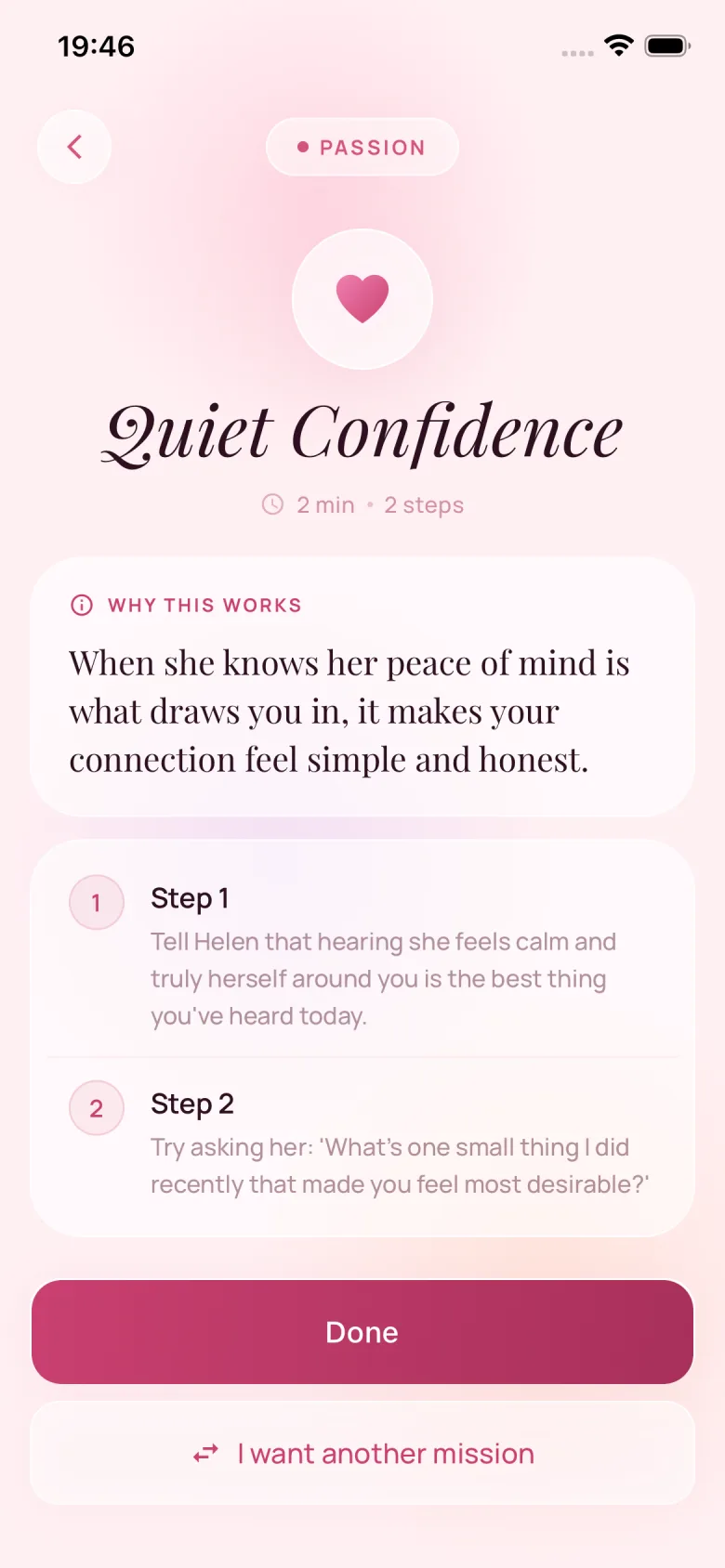
- Do tonight's micromission.Two steps, about two minutes: a flirty text, a question about their inner world, a gesture that isn't logistics. Written for your partner by name.
- Watch passion and fun come back on the map.Your Relationship Map shows communication, passion, trust, support and fun, so you can see the roommate habits loosening week by week.

Questions people ask
How long does the roommate phase last?
As long as nothing changes. Some couples slip out of it naturally when a busy season ends; others stay in it for years. Small, deliberate moments of connection usually start shifting the feeling within a few weeks.
Is the roommate phase normal in marriage?
Very. Most long-term couples go through it at some point, often after kids, a move, a demanding job or years of routine. It's one of the most fixable kinds of distance.
Can you get out of the roommate phase if only one partner tries?
One partner can usually start it. When you bring back warmth, curiosity and touch, most partners respond over time. If yours doesn't respond at all after a sustained effort, that's worth a direct conversation or a couples therapist.
Is the roommate phase the same as falling out of love?
Not necessarily. In the roommate phase the care and commitment are usually still there; what's missing is attention, novelty and affection. If you feel contempt, or one of you actively wants out, that's different and calls for a deeper conversation, ideally with professional help.
This guide is general information, not therapy or medical advice. If you feel unsafe in your relationship, or you're in crisis, please contact a licensed professional or your local emergency number.