 Withie
Get the app
When you feel distant
Feeling disconnected from your partner? Here's what's going on
You're not fighting and nothing is “wrong”, yet you feel far away from the person sitting next to you on the couch. It's a common feeling, it's usually fixable, and the way back starts smaller than you'd think.
Is it normal to feel disconnected from your partner?
Yes. Feeling emotionally distant from a partner you love is one of the most common experiences in long-term relationships, and one of the least talked about. People expect conflict to be the threat, but more often it's drift: months of being efficient teammates who rarely meet as people.
Some people describe it as being “lonely together”. You share a home, a calendar, maybe kids, and still feel like the other person doesn't quite know what's going on inside you right now. Or that you don't know what's going on inside them.
The feeling tells you that attention has gone elsewhere for a while. It doesn't say whether the relationship is good or bad; what you do next matters more.
Why it happens, even when you love each other
You're in logistics mode
When life is busy, conversations narrow to what needs to happen: groceries, pick-ups, bills. They're necessary, but they don't bring you closer, and a week of only logistics can feel like a month apart.
Stress spills over
When one or both of you is stressed about work, money or family, there's less bandwidth for curiosity and warmth. You come home empty and the relationship gets what's left.
Screens fill the gaps
The moments that used to become small conversations (waiting for dinner, lying in bed, the drive home) now get filled with scrolling. You lose dozens of small chances to connect, and none of them feels like a loss at the time.
Small hurts go unsaid
A comment that stung or a canceled plan seems too small to raise, so these things pile up quietly and create distance without either of you naming it.
One of you reaches, the other retreats
In many couples, one partner tends to push for closeness and conversation while the other pulls back under pressure. Each move triggers the other, and the gap widens. It's a pattern, so either partner can start changing it.
Quiet signs of emotional distance
- Most of your conversations are about tasks and schedules.
- You'd rather tell a friend about your day than your partner.
- You don't know what they're worried about this week.
- Affection has become rare, routine or only a prelude to sex.
- You both reach for your phones the moment you sit down together.
- Small annoyances feel bigger than they used to.
- You avoid bringing things up because “it's not worth a fight”.
If several of these sound familiar, you're in common company, and none of them have to be permanent.
“I feel disconnected for no reason”
Sometimes the distance isn't really about the relationship. If you feel flat or numb with everyone, not just your partner, look at the basics first: sleep, stress, burnout, health, low mood. Depression in particular often shows up as feeling disconnected from the people you love most. If that sounds like you, a doctor or therapist is the right first step, and it's worth telling your partner so they don't take the distance personally.
If it's specifically your partner you feel far from, ask yourself gently: when did I last feel close to them? What was different then? That often points straight to what's been missing.
How to bring it up without starting a fight
Telling your partner you feel disconnected can open a door or sound like an accusation, and the first sentence usually decides which.
“You never pay attention to me anymore.”
“I've been missing you lately, even though we're together all the time. I think we've both been running on empty. Could we find a little time that's just ours this week?”
Lead with your feeling, assume good intent, and finish with a small, specific invitation rather than a big demand. Pick a calm moment, not right after a stressful day. More on this in how to talk to your partner without fighting.
Five small steps back toward each other
- Turn toward the small stuff. When your partner shares something minor, look up and respond. The other steps build on this one.
- Ask one question that isn't logistics. “What's been on your mind this week?” is a start.
- Protect ten phone-free minutes a day. Same time and place if possible, so it turns into a ritual.
- Touch more, with no agenda. A hand on the shoulder, a longer hug, sitting closer than usual.
- Say the small hurts while they're small. Gently, in one sentence, soon after it happens. Things left unsaid create more distance than things said.
For a day-by-day version, try our 7-day plan to reconnect. If the distance has turned into a long stretch of living side by side, read about the roommate phase.
Close the gap one small step a day
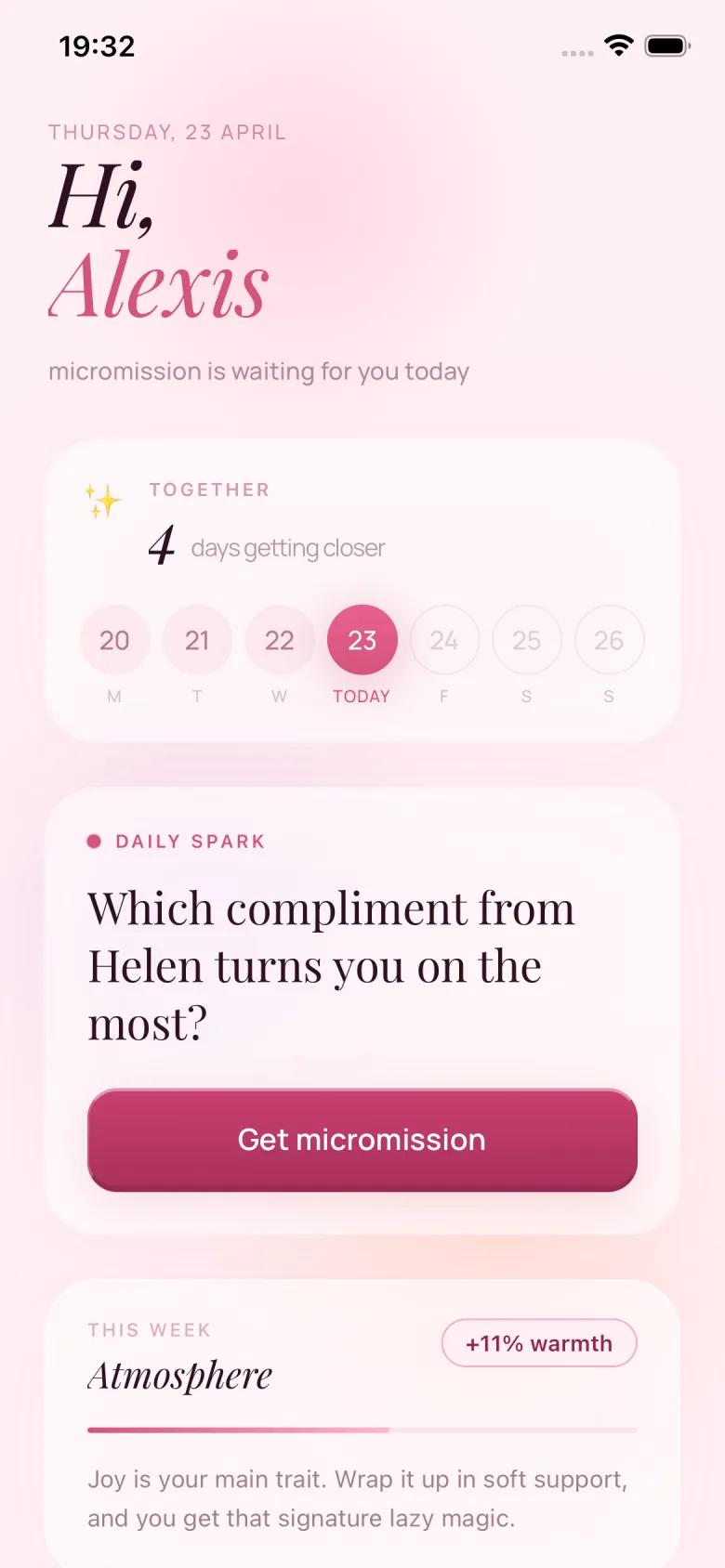
Disconnection builds up through small moments nobody notices, so the most reliable way back is small moments you both notice. Withie gives you one each day, chosen for your relationship and your partner.
- Tell Withie how things really feel.Each day there's one question about the two of you. Answer honestly and privately; your partner never sees it.
- Get one step back toward each other.Your answer becomes a 2-minute micromission: a question to ask, a thing to say, a small gesture, written for your partner by name.
- See the distance shrink.Your Relationship Map tracks communication, passion, trust, support and fun, so you can compare this week with last week.

Questions people ask
Is it normal to feel disconnected in a long-term relationship?
Yes. Almost every long relationship goes through stretches of distance, especially around busy periods, new babies, moves or job stress. It becomes a problem when it lasts for months and nobody names it or does anything small about it.
Why do I feel disconnected from my partner for no reason?
There's usually a reason, it's just quiet: stress, burnout, poor sleep, low mood, or a slow pile-up of small moments where you didn't feel seen. Check in with yourself first, then with the relationship. If the numbness is everywhere in your life, talk to a doctor or therapist.
Can a relationship recover from emotional distance?
Very often, yes, especially when it's caught early and there's still goodwill on both sides. Emotional distance builds through small missed moments, and it usually heals the same way: small moments of attention, repeated.
Should I tell my partner I feel disconnected?
Usually yes, but frame it as missing them rather than as a complaint: “I miss you, even though we're together every day” lands very differently from “you never pay attention to me”. Pair it with a small, concrete invitation.
This guide is general information, not therapy or medical advice. If you feel unsafe in your relationship, or you're in crisis, please contact a licensed professional or your local emergency number.